
Letters and numbers before kindergarten: what the research actually says
I'm a dad, not a teacher or a researcher. While building a letters game for my daughter, I wanted to know what a child “should” know before school. This is what the sources say, with a link to every one so you can check it yourself.
▶ Play now, it's free Jump to sources
The short answer
- There is no official number. No rule says a child must know a set number of letters to start kindergarten.
- Two research benchmarks get quoted a lot. A 2012 study by Piasta, Petscher and Justice, as quoted by Heinemann, found that “a benchmark of ten letters” at the end of preschool worked as a minimum screening line, and that “optimal benchmarks were eighteen uppercase letters and fifteen lowercase letters” (Heinemann blog). I read the summary, not the original paper.
- Typical ages are wide. Understood.org says children around age 3 “may recognize about half the letters” and around age 4 “often know all the letters of the alphabet and their correct order” (Understood.org).
- Plenty of children start school without them. See Don't panic below.
Why letter names matter
The National Early Literacy Panel reviewed the research on early literacy in 2009. Its summary says: “The strongest and most consistent predictors of later literacy development are alphabet knowledge, phonological awareness and memory, rapid automatized naming of letters and objects, and writing letters.” First on its list is “Knowing the names of printed letters” (NELP, Early Beginnings, PDF; full report, PDF).
One caution: a predictor is not a cause. Children who know letter names early tend to do better with reading later. That does not prove that drilling letter names creates a better reader.
Letter names or letter sounds first?
Reading researcher Timothy Shanahan writes that in the U.S., where many children arrive at school knowing some letter names, “it makes the greatest sense to start right there.” His conclusion: “Letters then sounds, or letters and sounds together, but writing included with either approach” (Shanahan on Literacy).
There are honest limits. In a study of 58 preschoolers, children taught names and sounds together learned more letter sounds, but “Benefits did not generalize to other emergent literacy skills” (Piasta, Purpura & Wagner, 2010). And not everyone starts with names: schools in England reportedly teach letter sounds first and bring in letter names later (Oxford Owl).
What about numbers?
The research I collected is mostly about letters. I did not find a verified national number for counting. State checklists differ. An Arkansas checklist for families reportedly mentions about ten letters and counting to 10, but I could not open the document to confirm it (Arkansas checklist, PDF). Your school district or your child's future teacher is the best source. If your child enjoys numbers, the game has four number modes for 1–10.
Don't panic
U.S. data collected in fall 1998 found that “66 percent of children entering kindergarten could recognize the letters of the alphabet” (NICHD, 2000). The data is old, but the point stands: about a third could not yet, and they started kindergarten anyway.
Official checklists are gentler than the internet. Indiana's kindergarten literacy readiness document gives no number of letters at all. It lists things like “Uses a variety of activities to recognize both uppercase and lowercase letters,” “Recognize own name in print” and “Forms some letters, shapes, and symbols with adult support” (Indiana DOE, PDF). Understood.org places matching each letter to its sound in kindergarten, not before it (Understood.org).
What BibyGames covers, and what it doesn't
BibyGames teaches capital letters and letter names only. Against the “eighteen uppercase and fifteen lowercase” benchmark, that is the uppercase half. There are no lowercase letters, no letter sounds and no reading in the game. It is not therapy and it is not a diagnostic tool.
In Trace, a green dot shows where each stroke starts and the strokes come in a fixed order. I don't claim this improves handwriting; I found no good evidence that tracing on a screen does. One pediatric occupational therapy blog is cautious about tracing in general and prefers clear start points, direction cues and hands-on activities (The OT Toolbox). Paper, crayons and play dough still matter.
How to check at home what your child knows
Let your child play Find for a few days. Then, in the menu, hold the gear icon for 2 seconds to open the parent settings. The Overview tab shows a grid of all letters and numbers: green means mastered, yellow in progress, orange needs practice. Each tile shows the number of attempts and the most common mix-up, for example B with D.
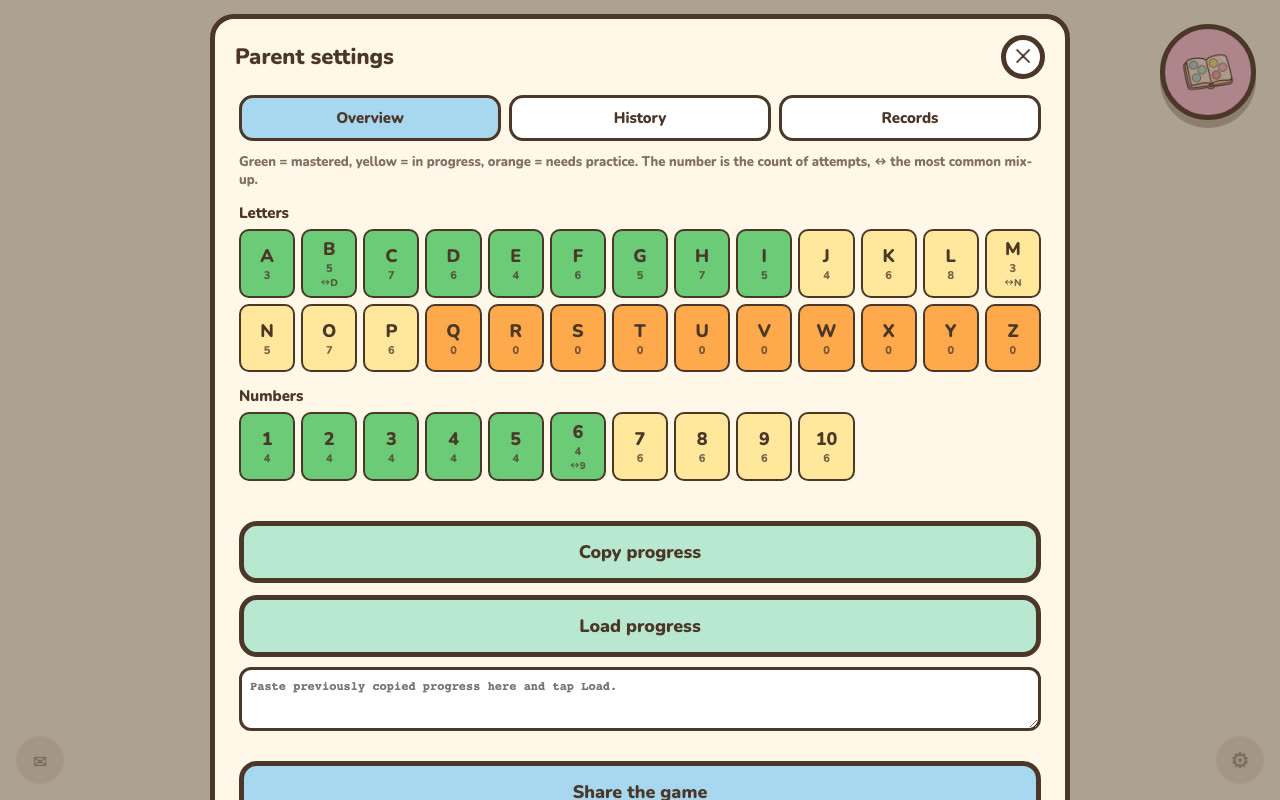
It takes a few minutes to read, and it only records play in this one game. It is not an assessment. Nothing in it leaves the device; more on the page For parents.
When to talk to a teacher or pediatrician
I can't tell you whether your child is on track, and neither can a game. If something worries you, or your gut says something is off, talk to your child's teacher or pediatrician. They know your child and can point you to the right help. Understood.org's article on when kids learn the alphabet is a calm place to start: When do kids know the alphabet?.
Common questions
How many letters should a 4-year-old know?
There is no official number. Understood.org says that around age 4 children “often know all the letters of the alphabet and their correct order,” and around age 3 they “may recognize about half the letters” (Understood.org). Many children are behind or ahead of that. Older U.S. data found that 66 percent of children entering kindergarten could recognize the letters (NICHD, fall 1998 data).
Should I teach uppercase or lowercase first?
The sources on this page don't settle that. The benchmarks quoted above count both, and the Indiana readiness checklist mentions “both uppercase and lowercase letters” (Indiana DOE, PDF). BibyGames has capital letters only, so lowercase needs to come from somewhere else: books, signs, paper and crayons.
Letter names or letter sounds first?
Reading researcher Timothy Shanahan sums it up as “Letters then sounds, or letters and sounds together, but writing included with either approach” (Shanahan on Literacy). Schools in England reportedly start with sounds instead (Oxford Owl). BibyGames teaches letter names only.
Should my child be able to write their name before kindergarten?
The Indiana kindergarten readiness checklist lists “Writes name” and “Forms some letters, shapes, and symbols with adult support” (Indiana DOE, PDF). The National Early Literacy Panel also names writing one's own name or single letters among the early skills linked to later literacy (NELP, PDF). That is about writing on paper. I have no evidence that tracing on a screen does the same job.
How high should a child count before kindergarten?
I did not find a verified national number. An Arkansas checklist for families reportedly mentions counting to 10, but I could not open the document to confirm it (Arkansas checklist, PDF). The best source is your own school district or your child's future teacher.
My 4-year-old can't remember letters. Should I worry?
I can't judge that, and neither can a game. Children come to letters at different ages. If something worries you, talk to your child's teacher or pediatrician. Understood.org has a clear overview of typical ages and next steps (Understood.org).
Do alphabet apps actually help?
I have no study showing that BibyGames, or any alphabet app, makes a child a better reader, so I don't claim it. In one small study, children taught letter names and sounds together learned more letter sounds, but “Benefits did not generalize to other emergent literacy skills” (Piasta, Purpura & Wagner, 2010). The American Academy of Pediatrics' 2026 guidance puts less weight on a fixed number of minutes and more on content quality, playing together and avoiding designs such as autoplay and targeted ads (HealthyChildren.org).
Sources
- Heinemann blog, quoting Piasta, Petscher & Justice (2012) on letter benchmarks
https://www.heinemann.com/blog/letter-a-week-ntbt1 - Understood.org: When do kids know the alphabet?
https://www.understood.org/en/articles/when-do-kids-know-the-alphabet - NICHD news release on America's Children (2000), kindergarten entry data from fall 1998
https://www.nichd.nih.gov/newsroom/releases/americasshows - National Early Literacy Panel: Early Beginnings (2009), PDF
https://www.nichd.nih.gov/sites/default/files/publications/pubs/documents/NELPEarlyBeginnings09.pdf - National Early Literacy Panel: full report (2009), PDF
https://lincs.ed.gov/publications/pdf/NELPReport09.pdf - Shanahan on Literacy: Letter names or sounds first?
https://www.shanahanonliteracy.com/blog/letter-names-or-sounds-first-you-might-be-surprised-by-the-answer - Piasta, Purpura & Wagner (2010), Reading and Writing
https://pmc.ncbi.nlm.nih.gov/articles/PMC2885812/ - Oxford Owl: What is Letters and Sounds? (England)
https://home.oxfordowl.co.uk/reading/what-is-letters-and-sounds/ - Indiana Department of Education: Kindergarten Literacy Readiness, PDF
https://www.in.gov/doe/files/K-Literacy-Readiness_update-10-8-21.pdf - Arkansas Kindergarten Readiness Indicator Checklist for Families, PDF (I could not open it)
https://dese.ade.arkansas.gov/Files/Kindergarten-Readiness-Indicator-Checklist-for-Families_2024_OEC.pdf - The OT Toolbox: To trace or not to trace?
https://www.theottoolbox.com/to-trace-or-not-to-trace/ - HealthyChildren.org (AAP): the 2026 digital media policy explained
https://www.healthychildren.org/English/family-life/Media/Pages/helping-kids-thrive-in-a-digital-world-AAP-policy-explained.aspx