
Learn numbers 1 to 10: count objects, find the number, trace the digit
BibyGames has four number games for kids aged 3 to 7. Biby the fox says every number out loud and counts along with your child, so no reading is needed. It is free, has no ads and no sign-up, and runs in the browser on a tablet, phone or computer.
▶ Play now, it's free Tips away from the screen
To get there, open the game and choose Numbers.
Four ways to play with numbers 1–10
Explore
Your child taps any digit from 1 to 10. It appears big on the screen with exactly that many objects around it. Biby names the number and counts the objects out loud. Nothing is scored.
Count
A pile of objects sits on the screen. Each tap on an object is counted out loud: “one, two, three…” Then your child picks the right number from the cards.
Find
Biby says a number and your child finds it among three cards, later four. This is number recognition: matching the spoken name to the written digit.
Trace
Your child traces the digits 1 to 10 with a finger along the dots. A green dot marks where each stroke starts, and the strokes come in a fixed order. You cannot fail.
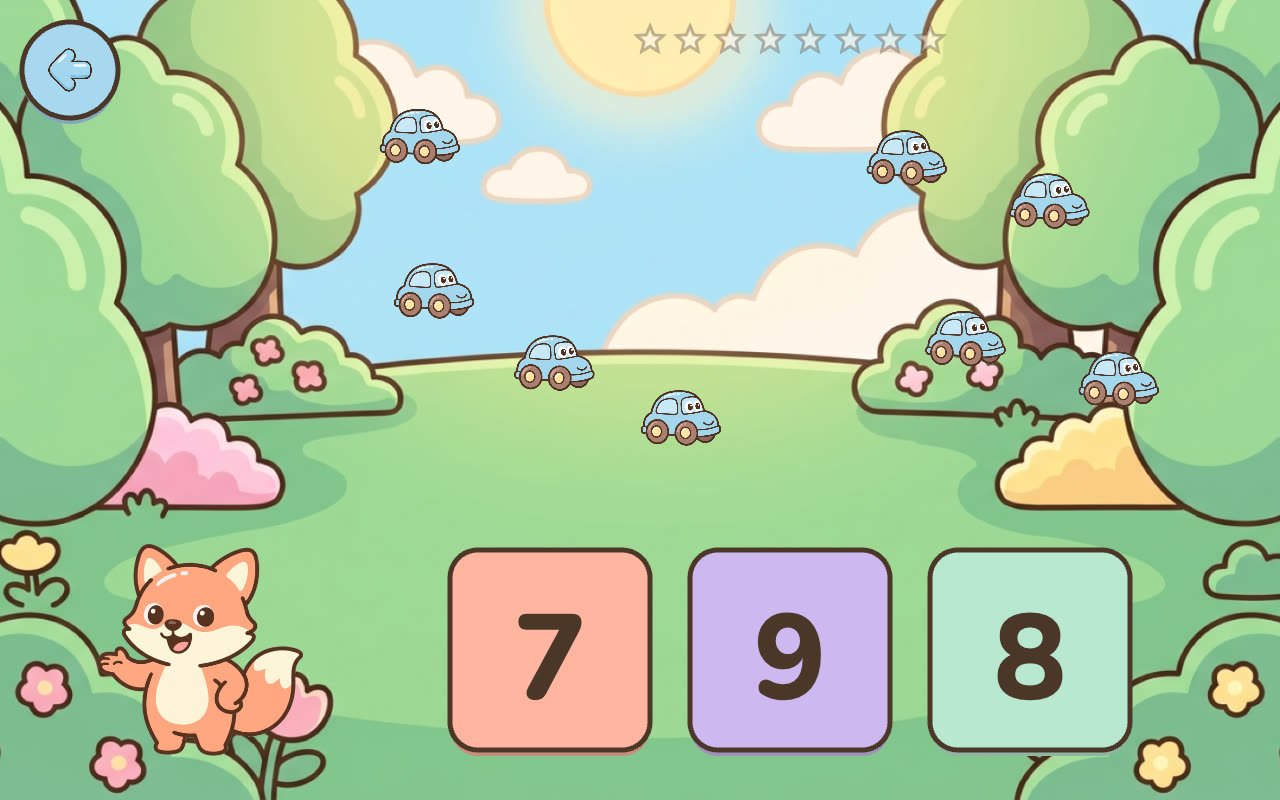
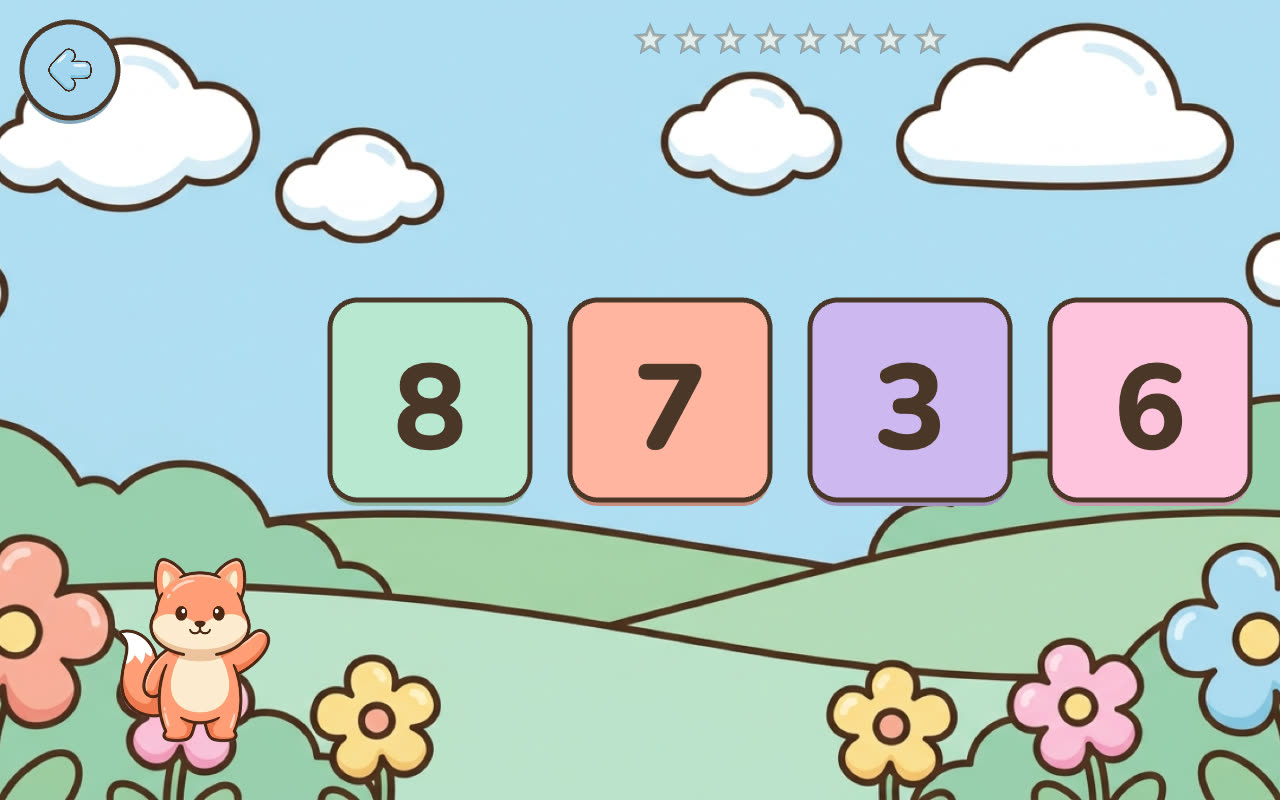
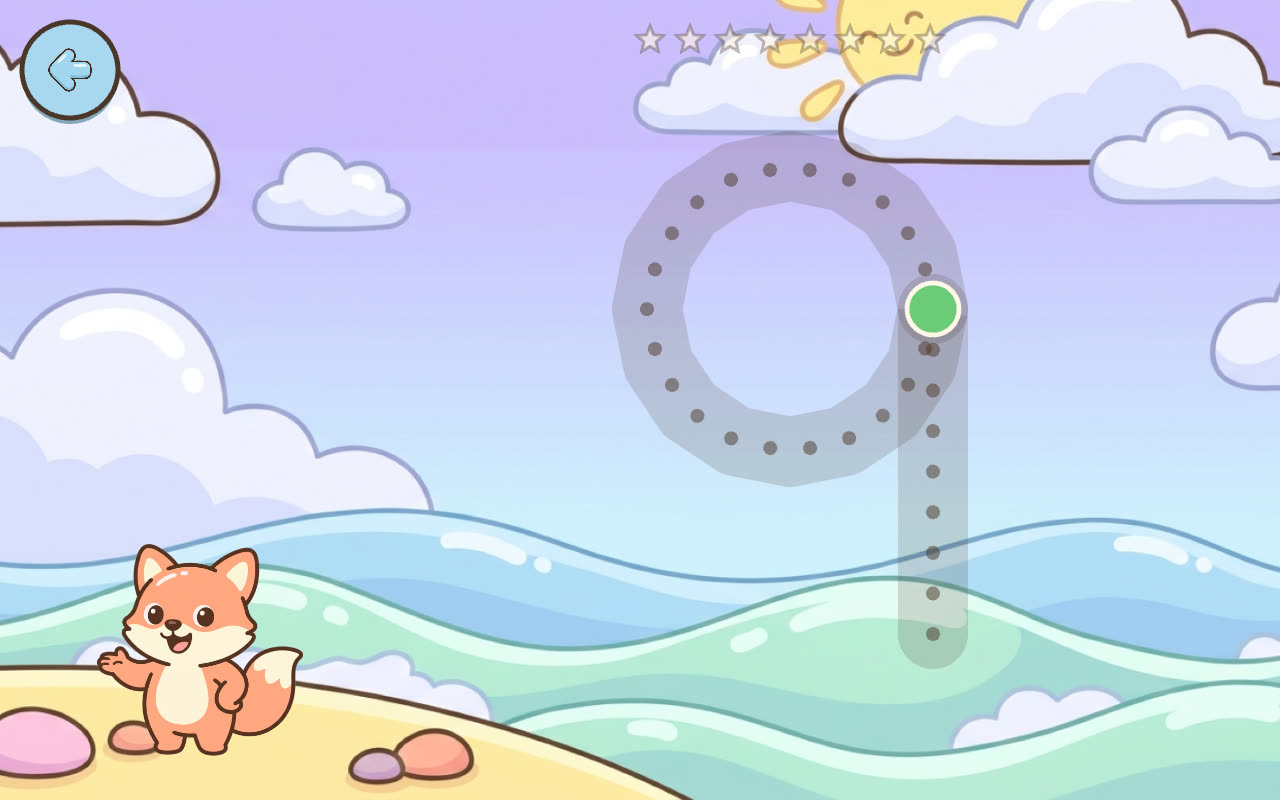
There are no timers and no penalties in any mode. After a mistake Biby encourages your child to try again, and after the second mistake she gives a hint. Each round earns one to three stars, and now and then a new sticker for the album of 20.
What your child practices
- Number names. Hearing “one” to “ten” said clearly by a clear American English voice, over and over, in every mode.
- Number recognition. Knowing that the spoken word “seven” goes with the written 7. That is what Find is for.
- One-to-one counting. One tap, one object, one number word. In Count, every tap is counted aloud, so the child can hear the link between touching and counting.
- How many. In Explore, the digit always comes with exactly that many objects, so 4 is never just a squiggle. It is four ducks.
- The shape of each digit. Trace shows where each stroke of a digit starts and which stroke comes next.
The game adapts as your child plays. Numbers that are not mastered yet come up more often, and the ones your child already knows show up less.
What it does not do: it stops at 10, there is no adding or subtracting, and it is not a test or a diagnosis of anything. It is a small game for getting comfortable with the first ten numbers.
See which numbers need practice
Hold the gear icon in the menu for 2 seconds to open the parent settings. The Overview tab shows a grid of numbers and letters: green means mastered, yellow means in progress, orange means needs practice. For each number you can see the attempts and the most common mix-up, for example whether your child keeps confusing 6 and 9. More about it in the guide for parents.
Tips away from the screen
A tablet is one small part of learning to count. None of these ideas need a screen, and they cost nothing:
- Count the stairs every time you climb them. One step, one number.
- Count snacks. “You can have five crackers. Can you count them out?” Handing over exactly five is harder than reciting to five.
- Set the table. One plate for each person is one-to-one matching in real life.
- Spot digits outside. House numbers, elevator buttons, the bus number, price tags.
- Draw big digits with chalk on the sidewalk or a finger in sand, right after tracing them in the game.
Short sessions work best, and they work better when you sit next to your child and count along.
Free, no ads, works offline
- Free, the whole game. All ten numbers and all four modes. No in-app purchases.
- No ads and no sign-up. There are no accounts.
- No data collected about your child. Progress is stored only on the device. I measure anonymous traffic only, with Google Analytics in cookieless mode.
- Works offline. The first launch is online and downloads about 20–25 MB of voice and pictures. After that everything works without internet, including the voice.
I'm Jan, a dad from the Czech Republic, and I built the game for my daughter. It also has letter games, including a letter tracing game for capital letters A–Z. Read more about why there are no ads and no accounts, or start from the home page.
Common questions
What age should a child recognize numbers 1–10?
Children vary a lot, and I am a dad, not a researcher, so I won't give you a number to worry about. BibyGames is made for ages 3 to 7. The youngest usually enjoy Explore, where nothing is scored, and move on to Count and Find when they are ready. If you have concerns, your child's teacher or pediatrician is the right person to ask.
What is one-to-one correspondence?
It means matching one number word to one object: touching each thing once and saying one number for it. A child who can recite “one, two, three” may still skip or double-count objects. In the Count mode, every tap on an object is counted aloud, which lets the child practice exactly this.
Does number tracing help preschoolers?
It can help a child get to know the shape of each digit and where its strokes start. I don't claim that tracing on a screen improves handwriting, because I have found no solid evidence for it. The OT Toolbox, a pediatric occupational therapy blog, writes that tracing has its time and place and works better with directional cues, alongside multisensory activities: To Trace or Not to Trace.
How do I teach number writing?
The game can show where each stroke of a digit starts and the order of the strokes. The writing itself is learned off the screen: big digits with chalk or a finger in sand first, then crayons on paper. Keep it playful and short, and don't worry about neatness early on.
Is it free? Are there ads?
It is free and there are no ads. There are no in-app purchases and no accounts, and no data is collected about your child. I measure anonymous traffic only, with Google Analytics in cookieless mode.
Does it work on an interactive whiteboard?
Yes. The game works with touch and with a mouse, so it runs on a computer or an interactive whiteboard in a browser. A group can count out loud together with Biby. There is more on the page For preschools.
Does it go beyond 10?
No. The number games cover 1 to 10 only, and there is no addition or subtraction.